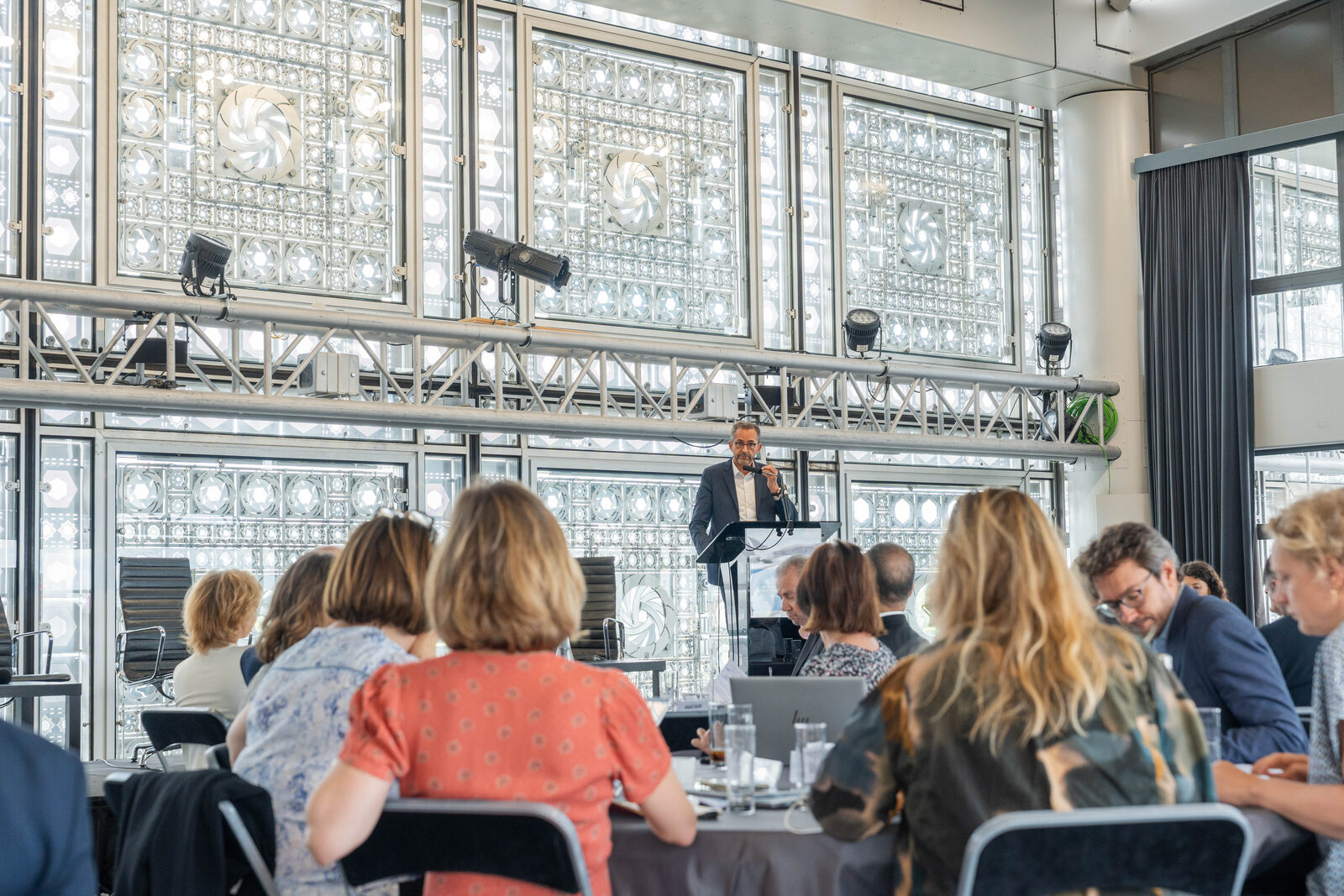
On 1 July 2026, at the seminar “From Training to Employment: Building Talent Mobility in the Mediterranean”, held at the Arab World Institute, the Committee for Action on the Mediterranean, the Agence française de développement and the Arab World Institute opened a working series dedicated to integrated pathways for training, employment and professional mobility between the two shores of the Mediterranean.
A high-level day
The day brought together two members of the French government, Jean-Pierre Farandou, Minister of Labour and Solidarity, and Roland Lescure, Minister of Economy, Finance and Industrial, Energy and Digital Sovereignty, as well as Nadia Hai, Ambassador and Interministerial Delegate for the Mediterranean (DIMED). Alongside Hakim El Karoui, President of the CAM, and Marc Reverdin, Secretary General, speakers included Christophe Lecourtier and Véronique Vouland, Director General and Executive Director of Geographies at AFD, Anne-Claire Legendre, President of the Arab World Institute, and Jean-Christophe Dumont, Director of the International Migration Division at the OECD, alongside businesses, universities and training stakeholders from both shores.
Moving from diagnosis to action
Bringing together French companies, training actors from the South, public institutions and mobility operators, the meeting made it possible to identify skills needs, take stock of existing instruments and define the conditions for better coordination between training and employment.
In a context of growing skills shortages and shifting migration dynamics, the initiative aims to move beyond fragmented approaches to mobility in order to build concrete, mutually beneficial solutions: better training, better recognition of skills, better support for career pathways and better responses to the needs of both shores’ economies.
The Mediterranean needs concrete solutions capable of transforming interdependencies into shared projects. The question of skills lies at the heart of this ambition: it touches on employment, youth, businesses, mobility and the capacity of both shores to build their future together.
— Hakim El Karoui, President of the Committee for Action on the Mediterranean
A series set to continue
This work is part of a broader partnership between AFD and the Committee. The exchanges initiated in Paris will continue in autumn 2026, at the Committee’s annual meeting in Morocco, focusing on adapting European immigration frameworks, structuring mobility pathways, recognising skills and developing training ecosystems on the southern shore. A session organised at the European Parliament will also open a dialogue between public development banks and international financial institutions on the financing of training, human capital and professional mobility projects.
These reflections build on the Committee’s 2026 report, The Mediterranean Through Work, which identifies demography and employment as the levers of renewed cooperation between the two shores.